BLOG // 2026.04.05 // 07:00 SGT
Strategic Presence in an Era of Autonomous AI
Reflecting on the compounding behavior required to navigate the rapid evolution of autonomous systems and data feeds, balancing career architecture with the reality of time as our ultimate constraint.
When I step back and observe the relentless velocity of information flowing into our daily lives, it often feels like we are standing in front of a firehose without a valve. Over the past few months, my automated systems have been capturing thousands of data points—everything from autonomous agent framework updates to nuanced financial terminologies. As a technology leader, the instinct is to consume all of it, to optimize the ingestion of data. Yet, the older I get, and the more health scares I reflect upon, the more I realize that unconstrained data consumption is fundamentally opposed to strategic presence.
Presence is not a soft skill; it's a strategic energy. How we direct that energy across the three core domains of our lives—Career, Finance, and Family—dictates the compounding behavior of our outcomes over decades.
The Illusion of Total Awareness
In my daily data streams, algorithms autonomously surface a myriad of signals. Recently, the feeds pulled in diverse concepts like niche real estate investment trusts, localized supply chain methodologies, and complex financial instruments.
On the surface, this represents the pinnacle of modern aggregation. We have built machines that can monitor the entire globe's financial, logistical, and ecological lexicon in real-time. But what is the actual value of this information if it merely creates noise? We must contrast these obscure data points with the actual, foundational shifts happening across major AI platforms.
If you look at the fundamental research coming from OpenAI, or the safety-driven advancements detailed by Anthropic, the true narrative is not about tracking every single micro-trend. It is about understanding the baseline models that will redefine our "time to solve problems."

The trap many technologists and engineers fall into is confusing awareness with understanding, and understanding with action. There is a deep, intrinsic danger in vanity metrics—whether it is the number of followers you have, the sheer volume of articles you read, or the number of data points your AI agent aggregates. The real measure of growth isn't volume; it is your "rate of change." When we focus too heavily on the noise, the time it takes to solve the right problems actually increases.
Options and Doors: The Architecture of Choice
In system architecture, we spend a lot of time discussing trade-offs. The same applies to our personal lives. I often use the mental model of "Options and Doors." Every piece of data we act upon opens certain doors and firmly shuts others. If I spend three hours analyzing a microscopic trend in a niche financial instrument, I am closing the door on three hours of focused, uninterrupted presence with my family or deep strategic planning for my engineering teams.
We see this same architectural discipline in how hyperscalers approach the market. When you examine the structured machine learning services provided by AWS or the enterprise AI infrastructure offered by Google Cloud, they are not trying to be everything to everyone instantly. They are building compounding systems. They are opening strategic doors that allow businesses to build scalable, reliable applications over the long term.
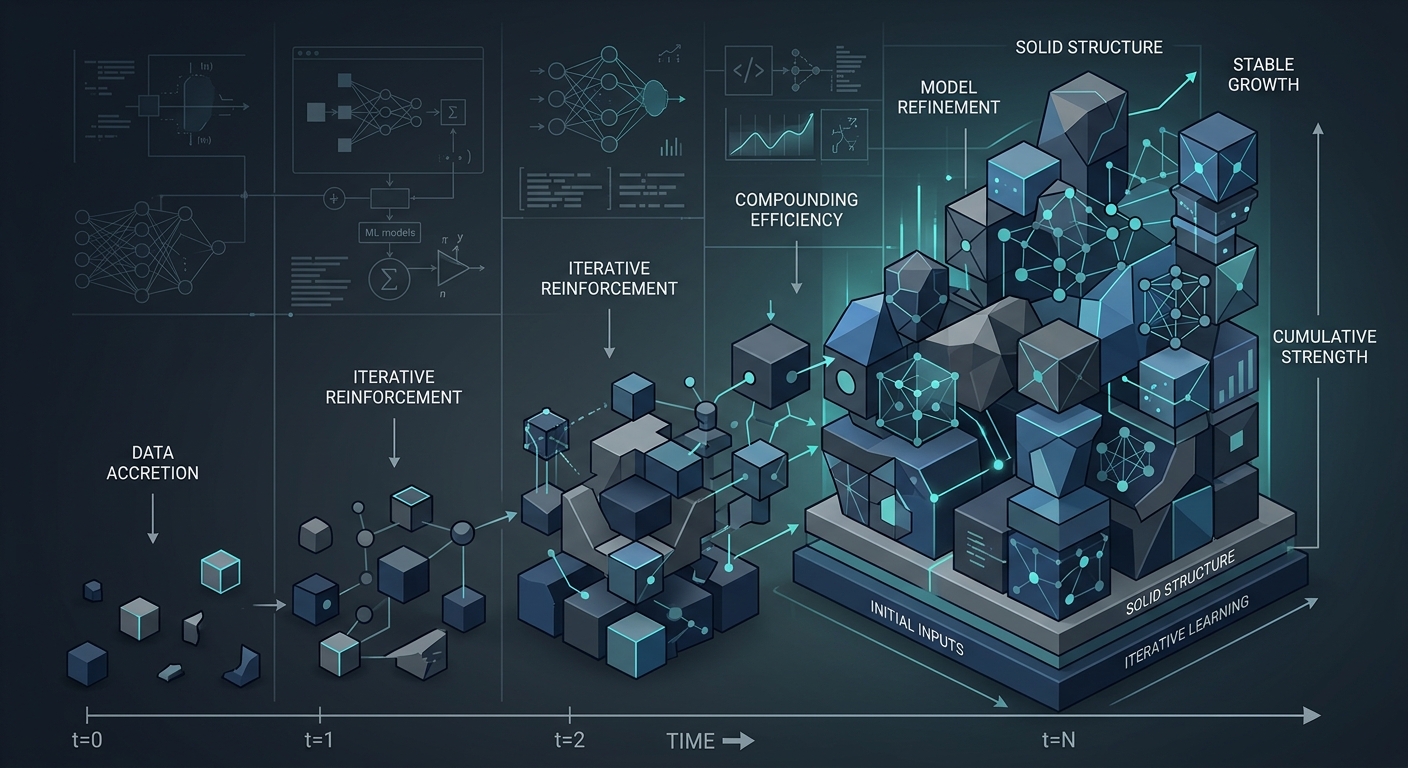
This brings me to the reality of time as the ultimate constraint. My experiences, particularly the health scares that force a sudden, stark reevaluation of priorities, have taught me to be fiercely protective of my calendar. Time is not a renewable resource. The moments we have with our children, the quiet evenings with our spouses, the focused hours mentoring a younger engineer—these are the compounding investments that actually yield meaningful returns.
When we look at the aggregation of financial tools or autonomous tracking, we should use them to buy back our time, not to fill it with more anxiety. The goal of automating the Firehose isn't to read everything; it is to let the machine filter the noise so we can walk away from the screen entirely.
Compounding Behavior in the Everyday
"How you do anything is how you do everything." This phrase echoes in my mind whenever I sit down to design a system or make a financial decision. The micro-actions we take every day compound. If we cultivate a habit of distraction—of constantly checking notifications or getting swept away by the hype cycle of the latest AI framework—we compound distraction. If we cultivate a habit of grounded, deliberate focus, we compound wisdom.

Being a better father and husband isn't about grand, sweeping gestures. It is about the daily baseline. It is the rate of change in how fully I listen when my family speaks to me at the end of a long day. If I am mentally reviewing a technical architecture or a financial chart while nodding along to my child's story, I am failing at presence.
To lead effectively at work and at home, we must embrace a philosophy of constraints. We must aggressively prune the inputs that do not serve our core domains. If a piece of news or a technological trend does not help me build a better career, secure my family's financial future, or improve the quality of my relationships, it is discarded. The true value of AI lies in its ability to take over the mundane so we can excel at the profound.
Going to the 'Why'
As leaders in the technology space, we have a responsibility to leave places better than we found them. This requires moving past the 'what' and the 'how' and relentlessly pursuing the 'why'. Why are we building this AI agent? Why are we tracking this data?

When we mentor, the greatest gift we can give is not a solution, but a framework for making decisions. Describing the trade-offs, showing the invisible costs of a particular architectural path, and teaching others how to filter signal from noise—these are the lessons that endure.
The future of technology will be increasingly autonomous. Machines will generate, analyze, and summarize data at a scale that human cognition cannot match. Our edge will not be our ability to process information. Our edge will be our humanity. It will be our capacity for empathy, our ability to maintain strategic presence, and our wisdom in knowing which doors to open and which to leave closed.
As we navigate this hyper-connected era, let us remember to anchor ourselves in reality. Ignore the hype. Protect your time. Cultivate presence. Compounding behavior takes decades to materialize, but it begins with the very next choice you make today. Be useful. Create value. And above all, be present.