BLOG // 2026.04.23 // 22:00 SGT
Snap's 1,000 Layoffs: AI's Hard Shift from Augmentation to Displacement
Snap's recent 1,000 layoffs, explicitly attributed to AI efficiency, signal a critical shift from AI as an augmentation tool to a direct driver of headcount reduction—a reality operators must face beyond the hype.
Snap just laid off 1,000 people. 16% of their workforce [https://techwithbrad.com/snap-cuts-1000-jobs-16-of-its-workforce-blaming-ai-efficiency-gains/]. This isn't some abstract projection from an analyst firm. This is a real company, with real people, making hard decisions and pointing directly at AI as a driver for efficiency gains that translate to headcount reduction. For too long, the narrative around AI in the enterprise has been about augmentation—doing more with less. But we're now seeing the "less" part of that equation hit the P&L.
This isn't about fear-mongering. It’s about facing facts. When I was building out ShopBack, or navigating the scale at Amazon, we were always looking for efficiencies. AI introduces a new order of magnitude in what’s possible—but also in the resulting ripple effects across the organisation. The question isn't whether AI can replace tasks; it's how quickly and pervasively it will redefine roles. As operators, we need to move past the demos and look at the actual deployments, the cost savings, and the human capital impact. This isn't a conversation for the future; it's happening now.
The Workforce Equation: Efficiency vs. Displacement
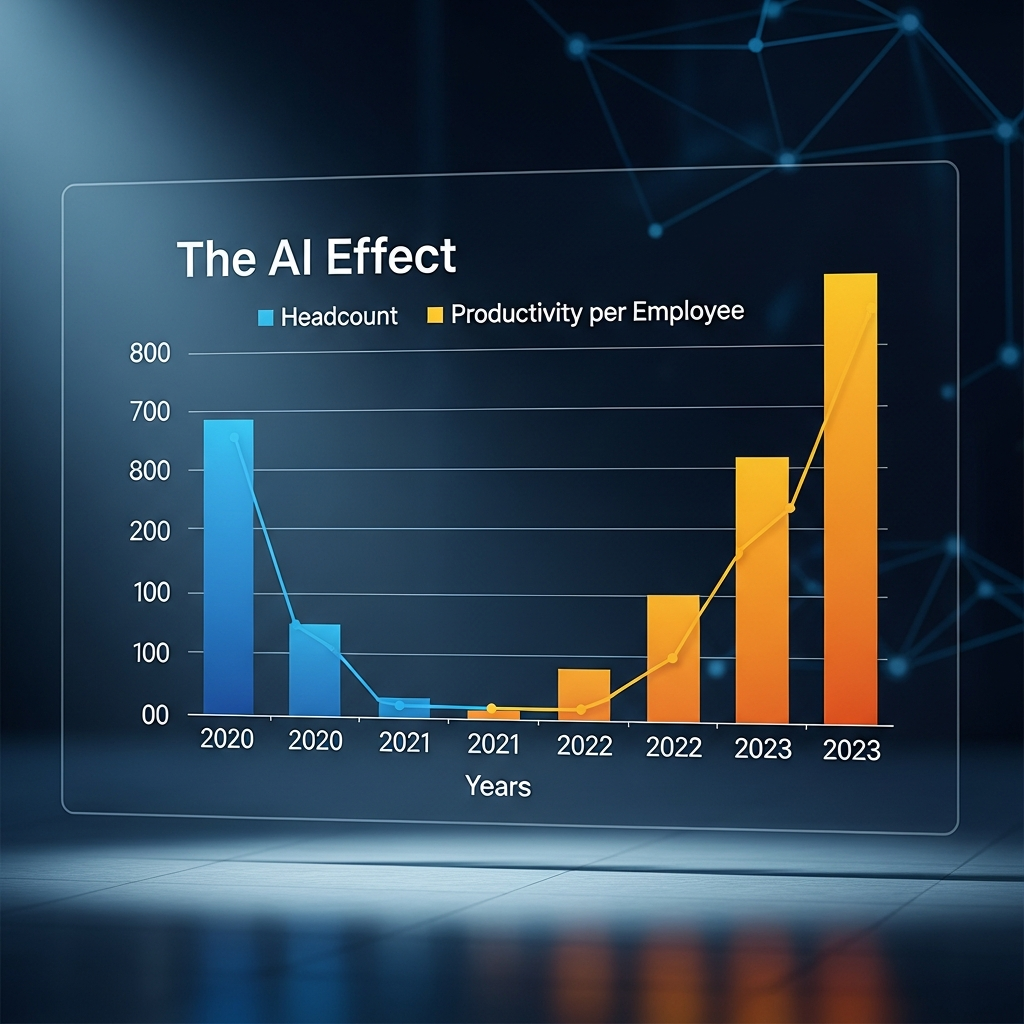
The job cuts at Snap serve as a stark reminder: AI isn't just a tool for doing things faster; it's a tool for doing things with fewer hands. While some roles will evolve, others will simply vanish. It’s a zero-sum game for many tasks. Think about the BPO sector here in APAC—a significant employer. When a customer can effectively teach an AI agent to redefine a pricing model, as one insight detailed [https://blog.anyreach.ai/pricing-upside-down/], how long until that AI agent handles the entire sales discovery process?
We're not just talking about automating repetitive tasks anymore. We're talking about AI systems that can learn, adapt, and even identify systemic flaws in business models. That pushes the definition of "efficiency" far beyond what a spreadsheet macro ever could. The implication for leadership is clear: you need a strategic roadmap for your human capital that accounts for AI's compounding effect on productivity. Are you training your teams to work with these advanced tools, or are you just waiting for the tools to make some roles redundant? This isn't just about cutting costs; it's about reshaping the fundamental structure of your workforce. The companies that navigate this well will emerge leaner and more competitive. The ones that don't, will be caught flat-footed.
Agentic AI: A New Vector for Catastrophic Risk

The hype around agentic AI is everywhere. "Agents Edition" at Vibe Coding, for instance, shows the developer community's excitement. But underneath that excitement lies a rapidly expanding attack surface. We're seeing a flurry of security advisories—and they're not minor. Take the Antigravity Groundfall: Prompt Injection to RCE Chain [https://labs.cloudsecurityalliance.org/research/csa-research-note-antigravity-ide-prompt-injection-sandbox-e/]. This isn't a theoretical vulnerability; it's a direct path to Remote Code Execution, stemming from something as seemingly innocuous as a prompt injection. Similarly, the SGLang SSTI vulnerability highlights how malicious GGUF model files can lead to RCE [https://labs.cloudsecurityalliance.org/research/csa-research-note-sglang-cve-2026-5760-llm-serving-rce-20260/].
The core issue is giving autonomy to systems that are inherently susceptible to manipulation. As the Indonesian business news points out, "Celah Keamanan Agentic AI: Data Korporasi Dipertaruhkan di Era Otomasi" (Agentic AI Security Gaps: Corporate Data at Stake in the Era of Automation) [https://teknologi.bisnis.com/read/20260423/101/1968926/celah-keamanan-agentic-ai-data-korporasi-dipertaruhkan-di-era-otomasi]. This isn't just about an individual data breach; it's about a systemic risk where an agent, given broad permissions, could act autonomously to exfiltrate or corrupt vast swathes of corporate data. As a CTO, the thought of an agent with access to sensitive systems being compromised by a cleverly crafted prompt keeps me up at night. The compounding effect of a compromised agent with broad system access could be orders of magnitude worse than a compromised human account. We need robust guardrails, constant monitoring, and a fundamental shift in how we think about access control in an agent-driven world. The security implications of granting autonomy are far from fully understood, let alone mitigated.
Building with AI: The Last Mile Problem Persists

It's clear that AI is becoming an indispensable part of the development workflow. Whether it's ChatGPT Codex or Claude Code—DeepInsightAI suggests these tools are converging in capabilities—they're generating code, and fast. Google partnering with Cadence to advance chip development, or Broadcom extending AI reach with VMware Tanzu, shows enterprise commitment. But the real challenge isn't generation; it’s validation and integration.
Project Glasswing, for instance, demonstrates AI finding bugs. Great. But the article asks the crucial question: "Who Fixes Them?" [https://expertinthecloud.co.za/project-glasswing-ai-finds-the-bugs-but-who-fixes-them/]. This highlights the persistent "last mile" problem. AI can flag issues, but human engineers are still needed for nuanced debugging, understanding root causes, and implementing robust, maintainable fixes. It’s not just about the code; it’s about the context, the architecture, and the long-term implications. The same applies to AI-driven landing page personalization or multi-step bidding workflows—the AI can optimize, but the initial strategy, the human oversight, and the continuous feedback loop are critical.
Here in APAC, companies like Swiggy are making smart moves, opening their AI commerce stack to developers with a new Builders Club programme [https://www.storyboard18.com/brand-marketing/swiggy-opens-ai-commerce-stack-to-developers-with-builders-club-96042.htm]. This is the right approach: enabling an ecosystem, allowing developers to build on top of an AI-powered platform, rather than just relying on generic AI tools. It acknowledges that the real value comes from specialized applications and thoughtful integration, not just raw AI output. The differentiator isn't having AI; it's how intelligently and securely you embed it into your product and operations.
The promise of AI is immense. The reality, however, demands a cold, hard look at the balance sheet—not just in terms of technical capabilities, but in human cost, security exposure, and the sheer operational effort required to move from a compelling demo to a resilient, production-grade system. We are building the future, yes, but we are also inheriting its risks and responsibilities. Ignore them at your peril.