BLOG // 2026.04.17 // 02:01 SGT
AI's Enterprise Pivot: From Hype to Hard Value
AI's shift from consumer novelty to enterprise solutions means the real battle is now about solving specific business problems, delivering measurable value at scale, and charging for outcomes, not model access.
It's 2 AM SGT. The news cycle on AI keeps churning, but the signal-to-noise ratio feels thinner than ever. We're past the "wow" phase of generative AI demos. Now, the real work begins—the hard, often unglamorous grind of making these systems actually work, reliably, at scale, and deliver measurable value. That's where most companies, especially here in APAC, are starting to feel the pinch. The honeymoon is over.
The Enterprise AI Pivot: Where the Real Battles Are Fought
We've seen the shift coming for a while, but it's becoming undeniable. OpenAI, the company that kicked off much of this current AI boom, is reportedly now "shifting its focus to business users amid Anthropic pressure" according to the Marin Independent Journal. This isn't surprising. Consumer-facing AI is expensive to run, hard to monetize consistently, and the novelty wears off fast. The real money, the sustainable revenue, sits in enterprise solutions.
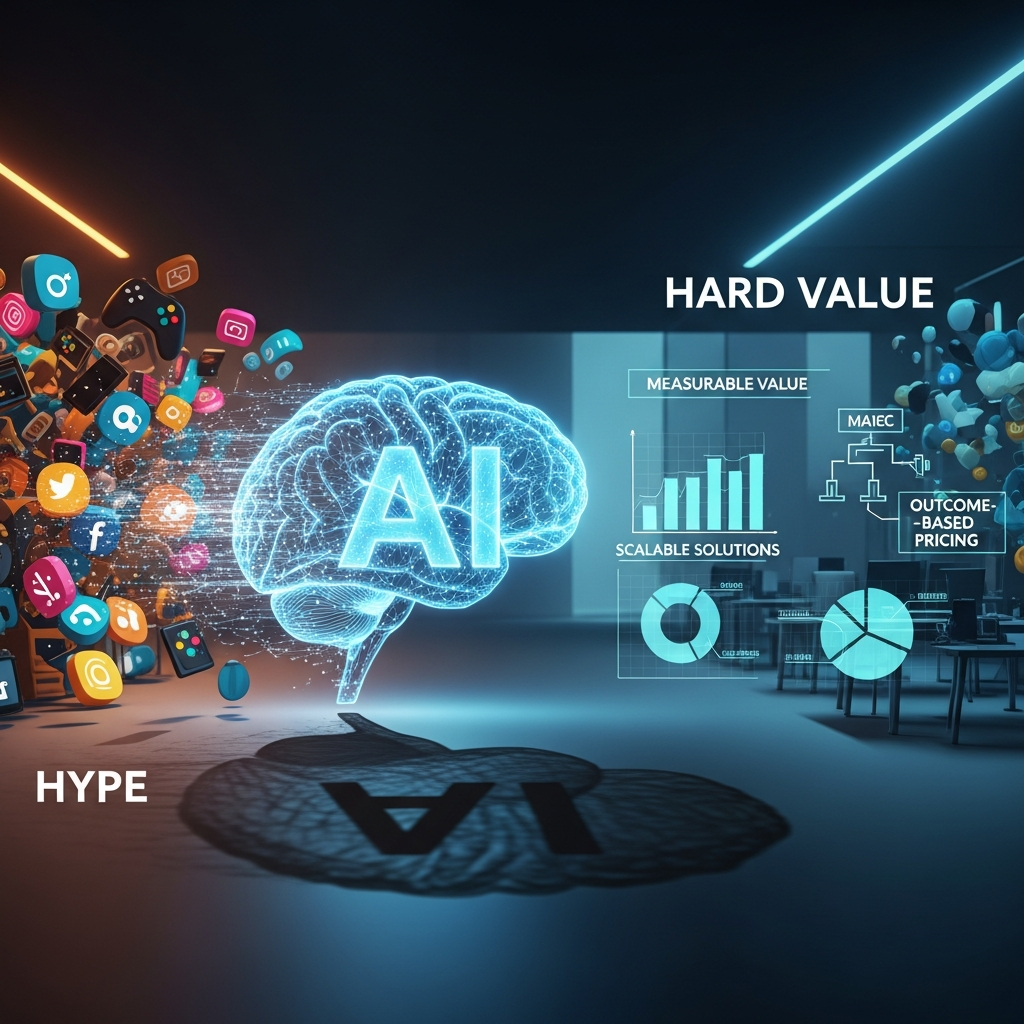
It's a familiar story for any tech company that started with a broad consumer play. You need to solve specific, painful business problems to justify the cost and complexity. HubSpot's recent move to "shifts AI pricing to per resolution, following Sierra's $150M ARR model" is another indicator. This isn't about charging for access to a large language model anymore. This is about charging for outcomes. You pay for a problem solved, a task completed, a customer query handled. This per-resolution model—a direct tie to business value—is a far more defensible and scalable approach than subscription to a generic chatbot. It forces product teams to focus on actual utility, not just features.
This also explains why we're seeing mergers like Startek and CCI Global forming a "global leader in Human Augmented AI." They understand that for many enterprise use cases—customer service, back-office operations, complex data processing—AI isn't replacing humans entirely. It's augmenting them. It's about efficiency gains, not full automation, at least for now. That kind of merger points directly to where the rubber meets the road: large-scale, cost-effective deployment where the human-AI partnership is the core value proposition.
Agentic AI: Beyond the Hype, Towards Practicality
"Agents" are the new buzzword. Everyone's talking about them, but what does it actually mean for builders? Canva AI 2.0 is reportedly bringing "Agentic Workflows to Creative Production." That's interesting. It suggests a move beyond simple prompt-and-generate to more complex, multi-step tasks where the AI itself orchestrates different tools and processes to achieve a creative goal. Think less "generate an image of a cat" and more "design a full marketing campaign for a new product, including images, copy, and social media posts, adapting based on feedback."

But here's the kicker: for agents to be reliable, they need serious tooling. OpenAI, recognizing this, is enhancing its Agents SDK with a "Sandbox And Scalable Tools." This isn't just about making agents; it's about making them testable, debuggable, and deployable at scale. You can't just throw an agent into production and hope it works. What happens when it makes a mistake? How do you trace its decisions? How do you update its knowledge or correct its behavior? This is where infrastructure like "Artifacts Versioned Storage - Git for AI Agents" becomes critical. It's version control for AI agents—a basic, non-negotiable requirement for any serious software development, now applied to autonomous systems. Without this kind of foundational tooling, agentic AI remains a demo, not a deployment. The details matter, always.
The Unforgiving Metrics of Real-World AI
We hear a lot about AI's potential, especially in high-stakes fields like finance. But the reality check is constant. The latest news confirms that "AI Trading Agents Are Moving Faster Yet Still Struggle" to beat humans in crypto markets. This isn't surprising to anyone who's actually built and deployed trading systems. The market is a complex, adaptive system. It doesn't care about your fancy algorithms or the latest LLM. It cares about consistent, risk-adjusted returns.

The delta between demo performance and live, sustained performance can be an order of magnitude, sometimes two. What looks like a 1% edge in a backtest can evaporate to a 0.1% loss in the wild—and that's before accounting for infrastructure costs, latency, and sudden market shifts. This struggle isn't a failure of AI; it's a stark reminder that AI is a tool, not a magic bullet. It excels at pattern recognition and speed, but human intuition, risk management, and adaptability in truly novel situations still provide an edge. The companies that understand this—that focus on practical, measurable improvements through augmentation rather than chasing full automation—are the ones who will actually build sustainable value.
The next phase of AI isn't about groundbreaking new models every month. It's about the grind. It's about engineering, integration, operational excellence, and, most importantly, proving return on investment. Anything less is just noise.