BLOG // 2026.04.17 // 22:00 SGT
AI's Agentic Shift: Autonomous Agents Automate Core Business
AI is rapidly moving beyond chat interfaces and advisory roles; actual deployments of autonomous agents are now executing core business operations, reallocating human capital and becoming a competitive necessity.
We’re past the point where AI was just a novelty. The hype cycle continues, sure, but what's emerging are actual deployments that shift how businesses operate. We're seeing AI move beyond chat interfaces and into the guts of daily operations, making decisions, executing tasks — essentially, becoming autonomous agents. This isn't theoretical anymore.
The Agentic Shift: AI Taking the Wheel
Remember when the buzz was all about large language models generating text? Useful, no doubt, but that was just the start. Now, we're seeing AI systems designed to act, not just advise. DriveCentric, for instance, just launched autonomous AI agents specifically for car dealerships. These aren't just answering FAQs; they're automating operations. Think about the sheer volume of repetitive, rule-based tasks in a dealership—scheduling, inventory checks, initial customer qualification. Automating that isn't about cutting costs; it's about reallocating human capital to higher-value interactions.
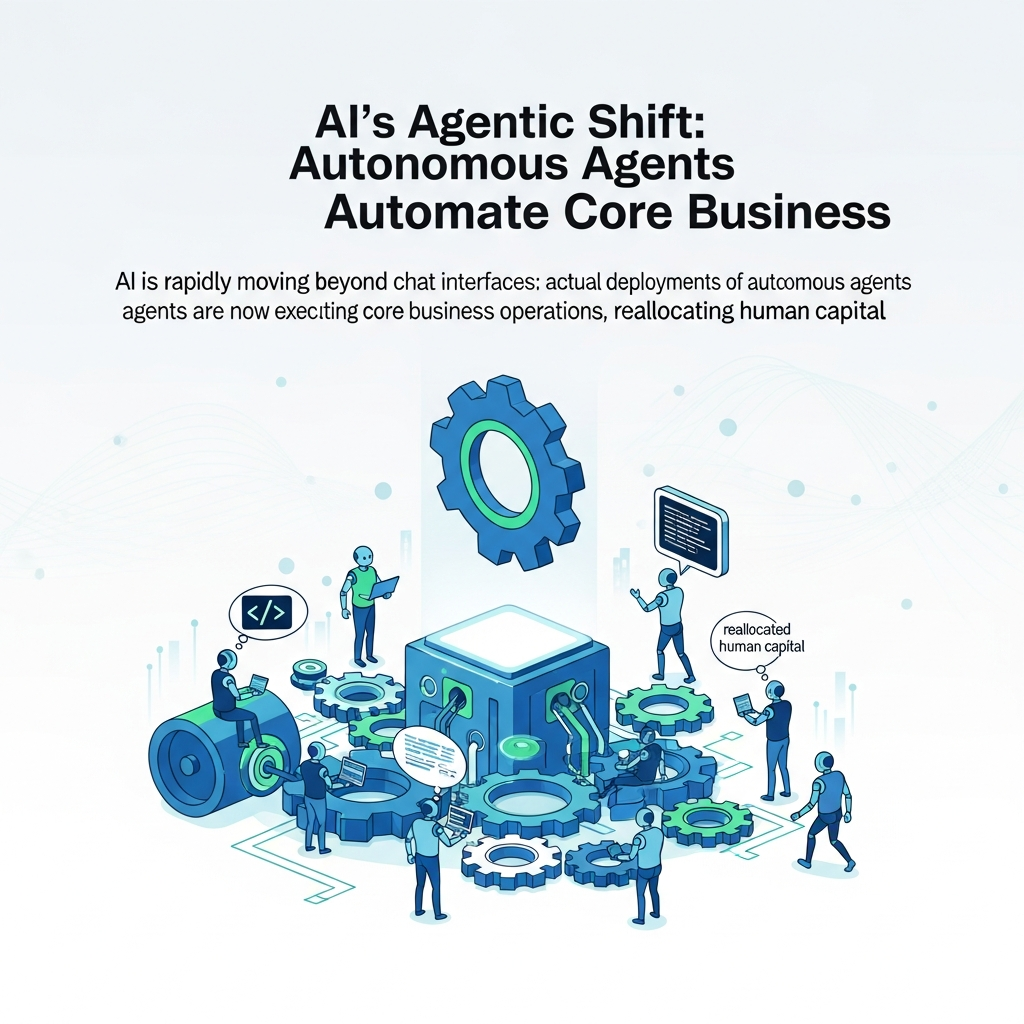
Similarly, Qu has introduced an AI commerce platform for restaurants. Anyone who's run an F&B business in Singapore knows the margins are razor-thin and labor is a constant challenge. An AI platform that can streamline ordering, manage inventory, and potentially even optimize staffing in real-time? That's not a luxury; it’s a competitive necessity. It means fewer errors, faster service, and ultimately, better customer experiences—all while trying to stay profitable.
Even giants like Salesforce are pushing this narrative. At TDX 2026, they introduced Agentforce Vibes 2.0 and AgentExchange. This signals a broader industry move towards "headless" operations, where the AI systems themselves are interacting with each other, making decisions, and executing workflows in the background. We're moving from a world where humans tell computers what to do, to one where humans define objectives, and AI agents figure out the "how." The implication? Your operational blueprint needs to change. Your tech stack needs to accommodate these autonomous workflows, not just react to human input.
This isn't just about incrementally improving existing processes. We're talking about a fundamental shift in how work gets done. The question isn't if your competitors adopt this, but when. And if they adopt it before you do, how much ground will you have lost?
The Unsexy, But Critical, Work of AI Governance
As these autonomous agents proliferate, making real-world decisions that impact revenue, reputation, and customer experience, the conversation quickly shifts from "what can AI do?" to "how do we trust what AI does?" This is where the unsexy, critical work of AI governance comes in.
IBM watsonx Governance for Trusted AI is a prime example of this growing need. It’s not just about building fancy models; it’s about ensuring they are fair, transparent, and explainable. Who is accountable when an AI agent makes a suboptimal decision, or worse, an outright error? What mechanisms are in place to audit its actions, understand its reasoning, and correct its course? These aren't abstract academic questions anymore. They're operational requirements.
Consider the Linux Foundation's work with the MCP (Multi-party Computation Protocol) for vendor-neutral governance. This highlights a critical challenge: as enterprise AI deployments grow, they often involve multiple vendors, proprietary models, and diverse data sources. Ensuring consistent, auditable governance across such a fragmented ecosystem is a nightmare without standardized, vendor-neutral protocols. The risk isn't just technical; it's reputational and legal. If your AI-driven system discriminates, or makes costly financial errors, the brand—and the bottom line—takes the hit.
The focus on "trusted AI" isn't just a marketing slogan from big tech. It's a foundational requirement for any enterprise serious about deploying AI at scale. Without robust governance frameworks—without the ability to trace, explain, and correct AI decisions—these autonomous agents become liabilities rather than assets. You can't just plug in an agent and walk away; you need to build the guardrails, the monitoring systems, and the human oversight loops. This is the difference between a demo and a reliable, enterprise-grade deployment.
The shiny new AI features get all the attention, but the real engineering challenge—and the ultimate competitive differentiator—lies in the operational rigor and governance frameworks that ensure these systems actually deliver value without blowing up your business. The future isn't just about building more AI, it's about building reliable AI.