BLOG // 2026.04.30 // 02:00 SGT
AI Agents: What's Actually Deploying?
Forget the flashy demos; the real work for AI agents is in building robust orchestration, integration, and management infrastructure to deliver tangible enterprise value.
The noise around AI agents has been deafening for months — demos, grand pronouncements, the usual hype cycle. But what’s actually moving the needle, what’s getting deployed, and what are the real operational shifts? Looking at the past 24 hours, the picture is complex, messy, and frankly, exactly what you’d expect when the rubber hits the road.
The Agentic Grind: From Demos to Deployment
We're seeing a clear push to move agentic AI from concept to enterprise reality. It’s no longer just about the foundational models; it’s about how they interact, orchestrate, and ultimately deliver value within existing systems. Sage, for instance, is deepening its collaboration with AWS to fast-track agentic AI for small and mid-sized businesses. This isn’t a moonshot — it's about practical application for a massive market segment that needs efficiency gains now, not next year. These businesses aren't building their own LLMs; they're looking for turnkey solutions that integrate.
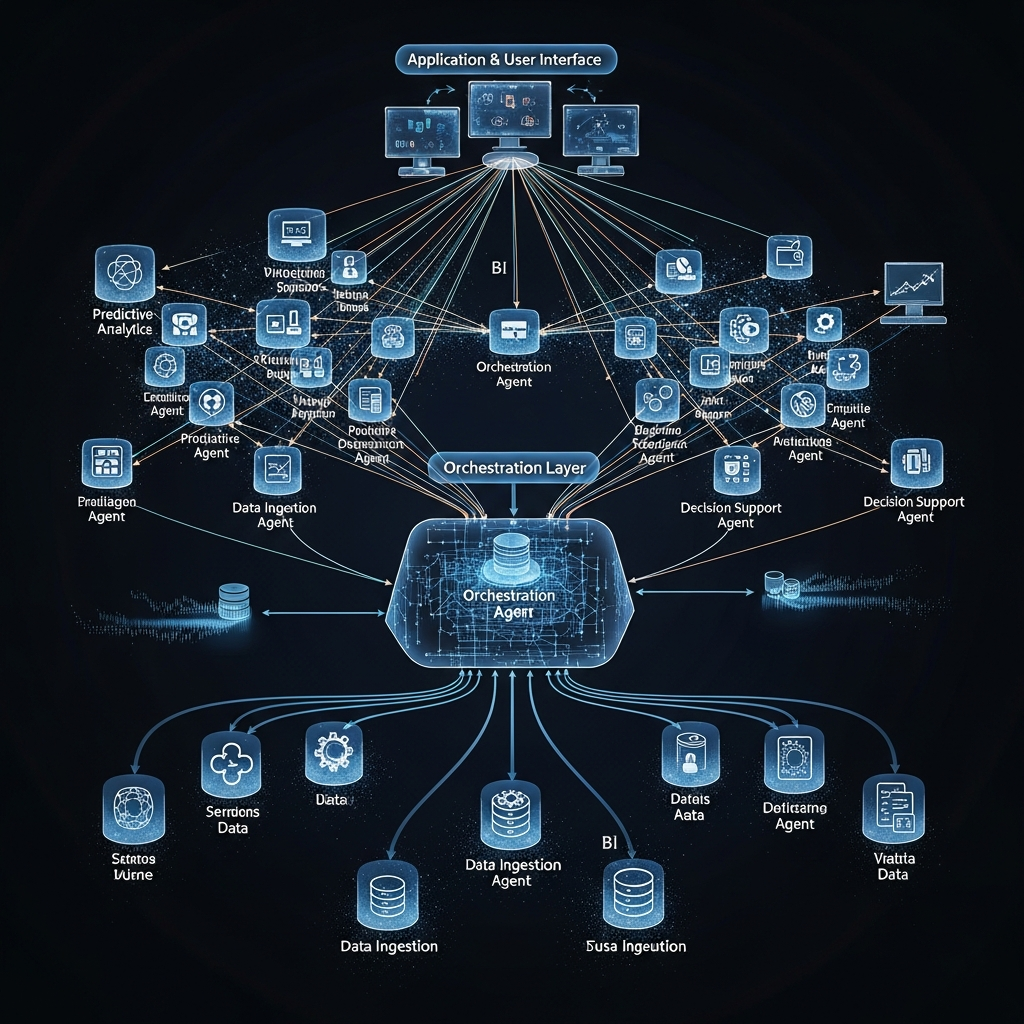
Similarly, Infor is launching AI orchestration tools to boost scaling, directly addressing the "scaling challenges" highlighted by recent research. It’s a necessary move. Building one agent is a demo; building a hundred that communicate, manage state, and recover from failure is an engineering headache. This is where the real work is. The market is maturing, demanding infrastructure to manage these distributed AI entities. You can see this reflected in the job market, too — AI Agents contract job trends are up, with specific skills like "Agentforce and Data Cloud Architect" showing up in job listings. This isn't just about data scientists anymore; it's about the architects who can wire this stuff together. BAND raising USD $17 million for a multi-agent AI layer isn’t surprising; the demand for robust, scalable agent infrastructure is undeniable. The market understands that agentic AI needs an operating system, not just a playground.
The Cloud Wars Intensify: OpenAI's Pivot and the Cost Curve
The biggest tremor this week has to be the reported gutting of the exclusive deal between Microsoft and OpenAI, freeing OpenAI to sell on AWS and Google Cloud. This isn't just a minor contract adjustment; it's a fundamental shift in the AI infrastructure landscape. For years, Microsoft positioned itself as the exclusive gateway to cutting-edge OpenAI models. Now, that competitive moat is eroding. What does this mean for enterprises? More choice, potentially lower prices as competition heats up, but also a more fragmented ecosystem. It forces AWS and Google to double down on their own offerings, while also giving them direct access to OpenAI's models, which could accelerate their own innovations.
But let's be pragmatic about "more choice." The underlying cost of AI is still a massive constraint. GitHub pausing Copilot sign-ups because "AI costs outgrow flat pricing" is a stark reminder. This isn't a bug; it's a feature of large-scale AI deployment. Running these models, even for seemingly simple tasks like code completion, consumes significant compute resources. Flat pricing models simply don't scale when usage explodes. Companies need to understand that the unit economics of AI are still being figured out. For every dollar saved in developer time, how much is being spent on inference? This is a question many are still struggling to answer meaningfully. Amazon, meanwhile, isn't waiting around — they've launched their own AI productivity software for office workers, directly competing in the application layer. The cloud providers are not just infrastructure plays anymore; they’re moving up the stack, building their own AI-powered applications to capture more value.

Geopolitics and the AI Acqui-Hire Frenzy
Beyond the tech and the economics, the geopolitical chess match continues to shape the AI landscape. China’s decision to kill Meta’s $2 billion Manus deal after a long probe is a loud signal. This isn't just about anti-trust; it’s about control over critical technology and data. Governments are increasingly viewing AI as a strategic national asset. Any acquisition involving a foreign entity and a promising AI startup will face intense scrutiny, especially in areas like data privacy or potential dual-use technology. For startups, this means M&A isn’t just about valuation and integration; it’s about navigating an increasingly complex global regulatory and political environment.
On the flip side, the talent war in AI is driving a relentless acqui-hire wave. OpenAI, for example, has reportedly closed its seventh acquisition recently. These aren't necessarily about acquiring massive user bases or groundbreaking IP in every case; often, it's about bringing in teams with specialized expertise, particularly in areas like model safety, alignment, or novel agentic architectures. When top talent is scarce and expensive, acquiring an entire team and their nascent product is often a more efficient path to growth than trying to hire individuals one by one. It’s a zero-sum game for talent, and the big players are playing it aggressively.

The confluence of these trends — the pragmatic push for enterprise AI, the evolving cloud landscape, the hard realities of cost, and the geopolitical maneuvering — means that building in AI today requires more than just technical prowess. It demands a keen understanding of economics, regulatory environments, and strategic partnerships. The foundational models are powerful, but their real-world impact hinges on the messy, complex work of deployment, integration, and navigating a world that's still figuring out what AI truly means for power and profit.