BLOG // 2026.05.01 // 22:01 SGT
AI Agents: It's Not the Agent, It's the Pipeline.
While the chatter is all about autonomous AI agents, the hard truth for production deployments isn't about individual intelligence, but robust pipelines and guardrails orchestrating complex workflows.
It’s May 2026, and the chatter around AI has shifted. We're past the initial "look, it can write a poem" phase. Now, the focus is squarely on "agents"—autonomous entities that can ostensibly act on their own.
The Agent Assemblage: Hype Versus Hard Yards
Every week, it feels like there’s a new announcement promising intelligent agents that will revolutionize everything. NVIDIA is pushing its "OpenClaw agents," aiming for AI to act on its own. Boomi is explaining "how enterprises are automating workflows in 2026" with their AI Agents. MeshKore’s directory is filling up with entries like "SwiftyChat — AI Infrastructure Agent" and "Transformer-in-generating-dialogue — General Agent." The sheer volume suggests a paradigm shift, doesn't it?

But let’s be direct: an agent is only as good as its pipeline and its guardrails. Talkvid.ai’s piece on "Build Very POWERFUL AI AGENT Pipelines Today" hints at the complexity. It’s not just about one agent; it's about orchestrating fleets. We're talking about sophisticated workflows, not just a standalone chatbot. The ability for these agents to perform complex "task-allocation-auctions," as another MeshKore entry suggests, implies a level of autonomous decision-making that is far from trivial to implement reliably in production.
We’re seeing early examples of vision-enabled agents shipping in the European Union, according to Callsphere. This is concrete—agents moving from concept to deployment in specific contexts. That’s the kind of progress we need to track: actual deployments, not just demos. My concern isn't the potential of agents, it's the operational reality. What happens when an agent makes a mistake? Who's accountable? These aren't just technical questions; they're business-critical. The "cringe" factor OpenAI is trying to "reduce" with ChatGPT 5.3 Instant shows that even foundational models still require continuous refinement based on user feedback. Imagine that feedback loop for a truly autonomous agent making financial decisions.
The Unsexy Imperative: Governance and Workforce Readiness
While everyone is busy building agent pipelines, the foundational layers of enterprise AI are still struggling. A Convertr insight piece bluntly states: "Your Data Governance Policy Isn't Working. Here's Why." This isn't surprising. AI, especially generative AI, thrives on data—and often uncurated, messy data. Without robust data governance, the outputs of even the most sophisticated agents are suspect. Garbage in, garbage out—only now, the garbage can make decisions at machine speed.
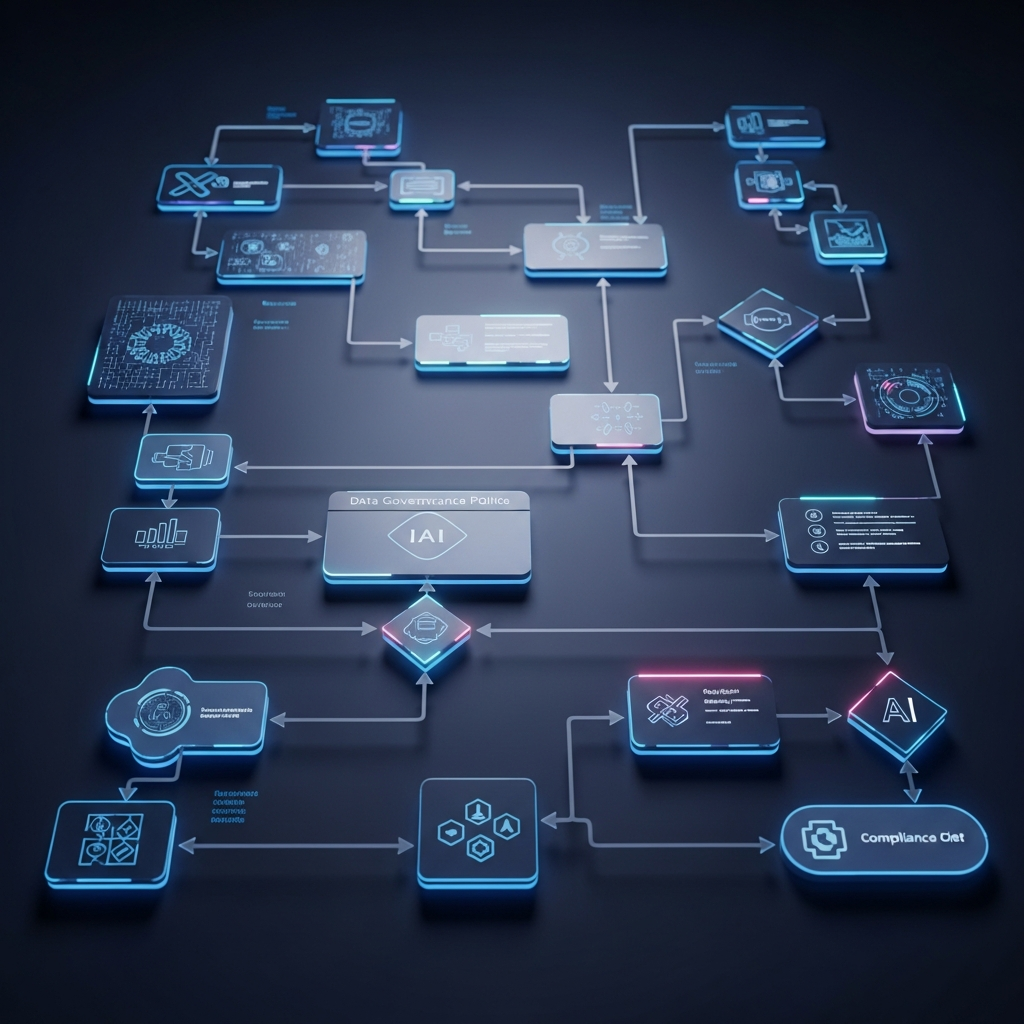
This leads directly to the human element. SAS has launched its AI Navigator specifically for governance oversight. This is not a luxury; it’s a necessity. If you’re deploying AI at scale, you must have a framework to understand what it’s doing, why, and how to intervene. Similarly, Prismforce has unveiled its AIQ platform for "AI Workforce Readiness." We can build all the agents we want, but if our teams aren't ready to deploy, manage, and troubleshoot them, the entire investment falls flat.
Benchmarking, too, is becoming critical. AIBizManual highlights "Enterprise AI Benchmarking Platforms 2026," emphasizing a strategic comparative guide. How do you know if your AI is performing? How do you compare it against alternatives? These are the practical, hard-nosed questions that separate pilot projects from scalable, ROI-positive deployments. It's about building a robust operating model, not just a cool piece of tech.
Where AI Actually Delivers: Measured Impact, Not Just Magic
Amidst the agent frenzy and governance headaches, there are clear signals of AI delivering tangible value in specific domains. This is where my focus remains: find the problems where AI offers an order-of-magnitude improvement.

Take ChatFin, for instance. They claim to deliver "97%+ AI Recon Accuracy on NetSuite." That's a specific problem, with a specific, measurable outcome. Reconciliation is a painful, manual process for many businesses. Improving accuracy by that much—and presumably speeding it up significantly—is a direct bottom-line impact. This isn't theoretical; it's operational efficiency.
The Global Industry Herald is asking "Can a Machine Outsmart the Rising Costs of Care with Artificial Intelligence For Healthcare Payer Market?" This points to another area ripe for optimization. Healthcare costs are astronomical, and if AI can genuinely cut administrative overhead, detect fraud, or optimize resource allocation, that’s a massive win. Similarly, Rabo Investments and Deutsche Börse are investing in Performativ to support wealth management. These aren't speculative bets on future capabilities; they're investments in firms applying AI to existing, high-value problems within established industries. Digital Wave and ChannelEngine partnering for "AI marketplace growth" is another example—using AI to drive measurable commercial outcomes.
The lesson here is simple: while the industry chases the next big thing, the smart operators are identifying specific pain points and applying AI to them with measurable results. The hype cycle will continue, but the compounding returns come from solving real problems, one accurate reconciliation or optimized workflow at a time. The rest is just noise.