BLOG // 2026.04.25 // 10:00 SGT
AI Agents: From Demos to Deployment
The AI conversation has shifted from chat to concrete action: agentic systems like OpenClaw and Amazon's Nova 2 Sonic are now autonomously executing complex workflows and building applications.
The conversation around AI is shifting. Not just from "what if" to "what now," but from "what can it tell me" to "what can it do for me." The latest news isn't about bigger models or fancier chatbots—it's about the plumbing, the economics, and the agents finally getting their hands dirty.
The Agentic Shift: AI That Doesn't Just Talk, It Works
We've moved past the novelty of generative AI. The real game changer isn't about a chatbot answering questions; it's about an AI that takes action, autonomously. This isn't theoretical anymore. OpenClaw's latest update, v2026.4.23, is a prime example, adding direct gpt-image-2 OAuth support and introducing a "Forked Context Mode" for sub-agents. This isn't just a feature bump—it's an architecture for distributed, collaborative AI tasks. As Metamorfosis Marketing Digital put it, we're seeing a clear transition "from ChatGPT to OpenClaw: when AI stops answering and starts working." [https://metamorfosis360.com/2026/04/24/de-chatgpt-a-openclaw-cuando-la-ia-deja-de-responder-y-empieza-a-trabajar/]
Think about it: OpenClaw is now being used to automate product documentation and even build apps, as Hostinger tutorials highlight. This isn't just about text generation; it's about chaining commands, interacting with external systems, and orchestrating complex workflows. Amazon is pushing this further with Nova 2 Sonic, enabling developers to build production voice AI agents on AWS in 2026. We’re moving beyond simple voice assistants to agents that can understand context, execute multi-step processes, and even recover from errors. This is the difference between a glorified search engine and a digital co-worker. The implications for productivity, especially in a tight labor market like Singapore's, are profound. But it also means the stakes are higher.

The Silent Battleground: Infrastructure, Costs, and the Search for Efficiency
All this agentic activity, all this "doing," requires immense computational power. And that power isn't free. The biggest tell isn't a new model announcement, but the underlying infrastructure plays. Consider Meta's strategic acquisition of tens of millions of AWS Graviton cores. LavX News reported this, highlighting the implications for AI infrastructure and the broader CPU market. [https://news.lavx.hu/article/meta-s-strategic-acquisition-of-tens-of-millions-of-aws-graviton-cores-implications-for-ai-infrastructure-and-the-cpu-market] This isn't about vanity projects; it's about securing capacity at scale and, crucially, managing costs. Graviton cores are custom ARM-based processors, typically offering better price-performance for many workloads than traditional x86 CPUs. When a hyperscaler like Meta makes a move like this, it signals a long-term commitment to controlling the economics of their AI operations.
This focus on efficiency is echoed in the model landscape itself. DeepSeek V4 is challenging GPT-5.5, not just on performance, but by offering its capabilities at one-sixth the cost, as AX BRIEF reported. [https://axbrief.com/news/news-wlrnw] Cost-per-inference is rapidly becoming the new frontier for competitive advantage. The days of throwing unlimited compute at every problem are over for anyone serious about production. We're seeing real-world scarcity too—the AgntAI report on $979 Mac Minis flooding eBay due to AI-driven demand isn't just an oddity; it's a symptom of the underlying hunger for accessible, local compute for development and specialized tasks. Every dollar saved on inference, every percentage point gained in efficiency, compounds across millions of transactions, translating directly to bottom-line impact. This isn't just about innovation; it's about making AI economically viable at scale.

Beyond the Demo: Mitigating Risk and Ensuring Observability
When AI agents start working, they also start making mistakes, or worse, creating liabilities. This isn't about a chatbot hallucinating; it's about an agent in a financial system taking an incorrect action. MindBridge's warning about "AI Agent Risk in Finance" is stark and necessary. [https://www.mindbridge.ai/blog/ai-agent-risk-finance/] As agents gain autonomy, the potential for unintended consequences—data discrepancies, compliance breaches, or even financial errors—skyrockets. The old adage "move fast and break things" doesn't apply when you're dealing with customer money or critical operations.
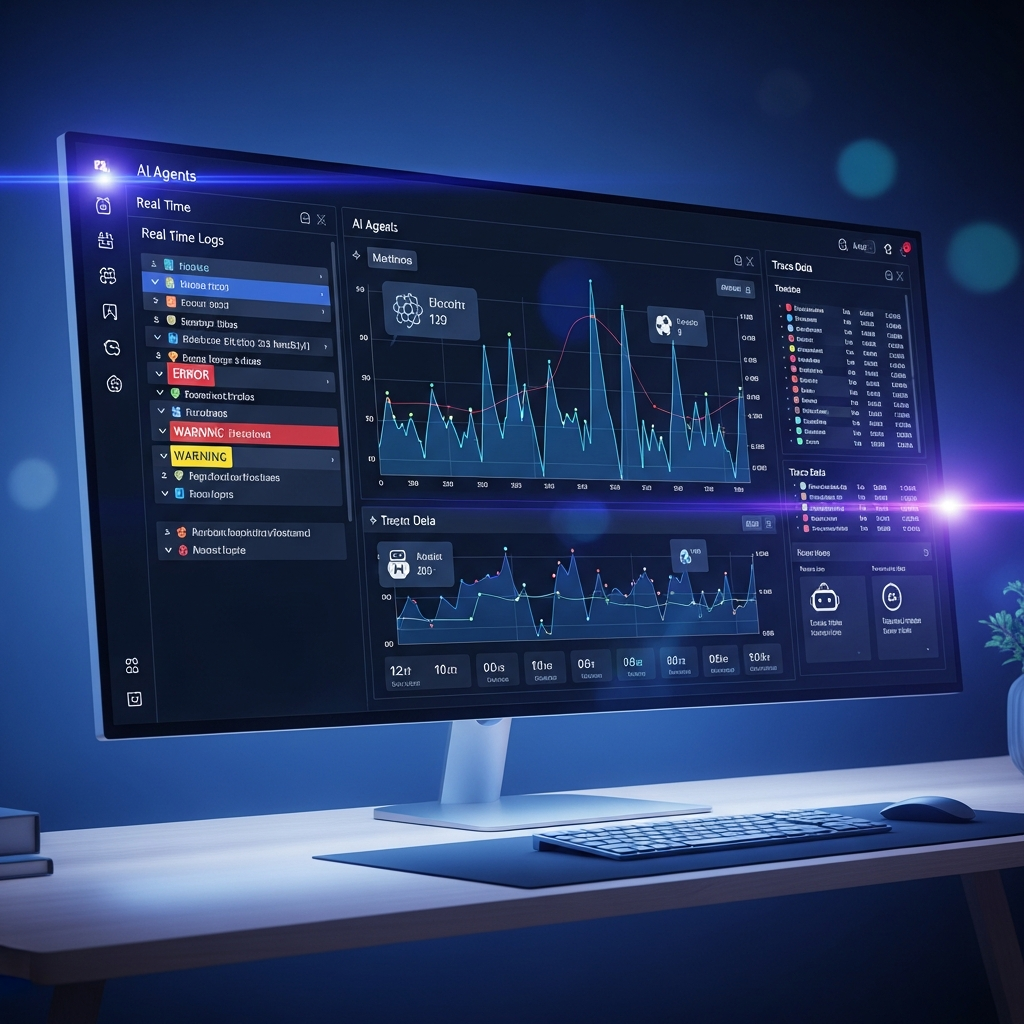
This is why observability for agentic AI is no longer a nice-to-have; it's fundamental. Groundcover is expanding its agentic AI observability for Vertex AI, for good reason. You need to know not just what an agent did, but why it did it, how it arrived at its decision, and what the blast radius of any error might be. Furthermore, the U.S. Navy AI Testing Challenge, won by QualityWorks, highlights the critical importance of rigorous testing for AI systems in high-stakes environments. We’re building complex, self-modifying systems. Without robust testing frameworks, clear audit trails, and real-time observability, deploying these agents in production is not just risky—it’s irresponsible. The future isn't just about building agents; it's about building agents we can trust, monitor, and, if necessary, control.
The shift is undeniable. AI has moved past the talking points and into the trenches. It’s no longer about dazzling demos; it’s about reliable production deployments, sustainable economics, and robust risk management. If you’re not thinking in these terms, you’re not building for the future—you’re still playing with toys.