BLOG // 2026.04.29 // 10:01 SGT
Agentic AI: The Operator's Reality Check
Agentic AI promises autonomy, but operators must look past demos to real-world reliability and problem-solving. Distinguishing true agents from glorified scripting is critical for impact.
The buzz around "agentic AI" is everywhere. Every other demo now promises an autonomous agent that will write your code, manage your calendar, or even run your company. On the surface, it sounds like the next logical step beyond a smart chatbot—an AI that doesn't just respond, but acts.
But for operators, the question is always: what problem does it solve, and how reliably?
The Agentic Future: Beyond the Demo Loop
I see the headlines touting companies like Tearline, which is apparently "building the intelligent execution layer for an agentic future" from Hong Kong to Paris. The promise is alluring: an AI that can move beyond simple API calls and actually orchestrate complex tasks, making decisions and taking actions. It's the vision of truly "intent-driven engineering," as some are exploring. This isn't just about a smarter IDE; it's about shifting the paradigm of how software gets built and operated.

Yet, for every Tearline pushing the frontier, there’s a glut of demos that feel like glorified scripting. The distinction is crucial. An agent that delegates, reviews, and owns a task, as one framework suggests, is fundamentally different from a tool that just automates a single step. We need to be wary of the hype cycle here. Is it a true autonomous system making reasoned choices across multiple domains, or is it a cleverly chained sequence of prompts and existing APIs? The former is transformative, the latter is often just an expensive, brittle script.
The market certainly thinks there's substance. Institutions like IITM Pravartak and Emeritus are launching professional certificate programmes in "Agentic AI and Applications" in India. This signals a growing belief that these capabilities are real enough to warrant dedicated education, moving from academic research to practical application. And yes, I'm seeing job postings for "Agentic AI Software Engineer" roles. The demand is there, but the definition of what an agent truly is, and what it can reliably achieve in a production environment, is still evolving rapidly. It’s early days, and many will overpromise and underdeliver before the real value emerges.
The Enterprise Grind: Skills, Strategy, and Social Friction
While the cutting edge of AI agents captures headlines, the broader enterprise adoption story is a messy, human one. Governments and large corporations are grappling with a massive skills gap and the sheer inertia of existing systems. Europe, for instance, is racing to close this gap, with the EU Pact for Skills training 10 million workers. That's a staggering number, indicative of the scale of transformation required—not just in tech teams, but across the entire workforce.

We’re seeing enterprise giants like NEC announce strategic collaborations with Anthropic, focusing specifically on enterprise AI. This isn't about flashy consumer apps; it's about integrating AI into core business processes, often with legacy systems and stringent security requirements. It's slow, it's expensive, and it's absolutely necessary for competitive advantage. The CEO of a $25.9 billion bank even had an AI clone lead an earnings call recently. That's a powerful demonstration of trust—or perhaps a calculated risk—in AI's ability to handle high-stakes communication. But even with such advancements, the human element remains paramount.
Consider Palantir. They’re a significant player in the enterprise AI space, but employees are sounding alarms over the company’s role in immigration enforcement. This isn't a technical bug; it's a fundamental challenge of deploying powerful AI systems into sensitive societal contexts. Technology does not operate in a vacuum. Every AI deployment, especially at enterprise scale, comes with ethical, social, and operational baggage. Ignoring this means you're building a ticking time bomb, not a robust solution. The best code means nothing if it's deployed irresponsibly or causes more problems than it solves.
The Race to the Bottom: Commoditization and Value Capture
Then there's the relentless march of commoditization. China's DeepSeek recently released a new AI model, and almost immediately, news broke that they are slashing API costs, signaling a "new intensity in China's AI price war."
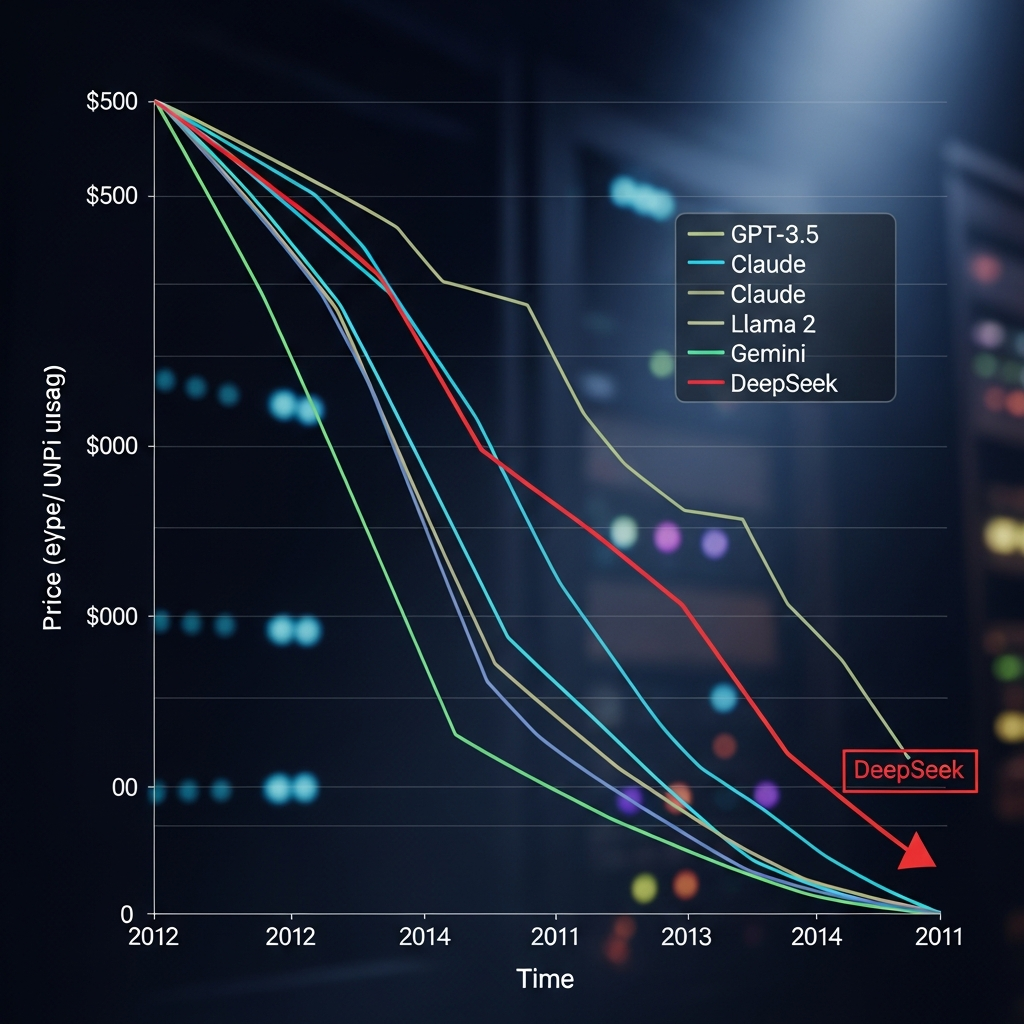
This is a familiar pattern in tech. Compute becomes cheaper, models become more accessible, and the underlying infrastructure becomes a commodity. For builders, this is a double-edged sword. On one hand, cheaper access to powerful models means lower barriers to entry for new AI applications. On the other hand, if your core value proposition is simply wrapping an API call to a foundational model, your margins are going to evaporate faster than water in a Singapore summer.
The real value shifts to integration, domain expertise, and defensible data moats. It’s about understanding specific customer problems so deeply that your AI solution, even if built on commodity models, delivers an order of magnitude more value than the sum of its parts. If you're betting your business on the cost of a token, you've already lost.
The AI landscape in 2026 is a blend of audacious vision and grinding reality. We're seeing pockets of genuine innovation, massive efforts to upskill entire workforces, and the inevitable commoditization that forces everyone to rethink where true value lies. The challenge, as always, is distinguishing the signal from the noise—and building something that actually works, reliably, and ethically, in the real world.